
🧠 Your Brain
Train it like a muscle
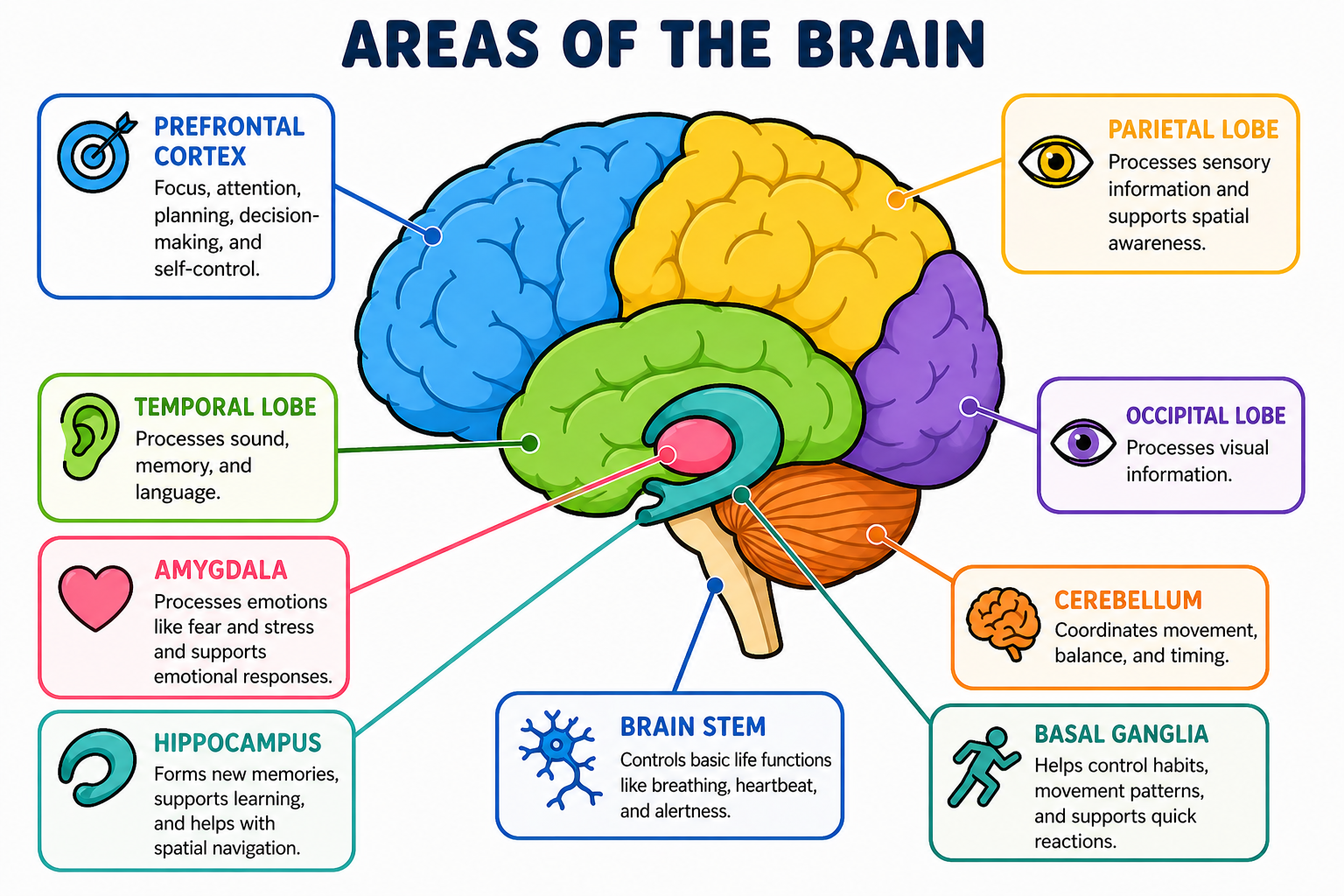
Your brain is your control center
Your brain helps you think, move, feel, learn, and make decisions. Just like your muscles get stronger with exercise, your brain gets stronger when you train it.
⚡ How your brain gets stronger
Inside your brain are billions of tiny connections called neurons. Every time you focus, solve a problem, remember something, or stay calm, you strengthen those connections. This is called neuroplasticity — your brain's ability to grow and change.
How The Brain Dojo Trains Your Brain
Focus
Prefrontal Cortex (front of the brain)
Helps you concentrate, block distractions, and stay in control.
When you practice focus, your brain gets better at ignoring distractions and staying locked in.
Better school focus, better listening, and stronger discipline.
Memory
Hippocampus
Stores information and helps you remember things.
Every time you remember something, your brain strengthens memory pathways.
Learning faster, remembering techniques, and following directions.
Speed
Neural Pathways
Helps you process information quickly and react faster.
The more you practice, the faster your brain sends signals. This is called myelination, which helps your brain work more efficiently.
Faster reactions in sports, quicker thinking, and better timing.
Problem Solving
Frontal Lobes
Helps you plan, solve problems, and make decisions.
When you solve challenges, your brain builds stronger thinking pathways and improves decision-making.
Solving challenges, making smart choices, and staying calm under pressure.
Awareness
Parietal Lobe
Helps you understand space, movement, and what is happening around you.
When you train awareness, your brain gets better at detecting movement and understanding your surroundings.
Sports, safety, coordination, and self-defense awareness.
Emotional Regulation
Amygdala and Prefrontal Cortex
Helps you understand, manage, and respond to your emotions in healthy ways.
Training emotional regulation strengthens the connection between the prefrontal cortex (thinking brain) and the amygdala (emotion center), so you can stay calm instead of reacting on impulse.
Staying calm under pressure, handling frustration, and making better choices when emotions run high.
Meditation - Restoration
Prefrontal Cortex and emotional control centers
Helps calm your mind, reduce stress, and improve focus.
Meditation helps lower stress signals in the brain and strengthens emotional control.
Staying calm, managing emotions, and improving focus.
Nutrition
Nutrition Tips for a Strong Brain
Your brain is mostly made of water.
When you don't drink enough:
- ❌ Thinking slows down
- ❌ You feel tired
- ❌ Focus becomes harder
Drinking water helps your brain:
- ✅ Stay alert
- ✅ Think clearly
- ✅ React faster
💡 Simple Tip: Drink water throughout the day, especially before training or testing your brain.
When you eat a large meal:
- • Your body sends more blood to your stomach to digest food
- • Less energy is available for your brain
This can make you feel:
- 😴 Sleepy
- 🐢 Slower
- 😶🌫️ Less focused
💡 Simple Tip: Eat light before brain training. Avoid heavy meals right before.
Here is the best way to prepare your brain:
Do:
- ✅ Drink water
- ✅ Eat something light such as fruit, nuts, or yogurt
- ✅ Take a few deep breaths
Don't:
- ❌ Eat a heavy meal right before
- ❌ Drink too much sugar
- ❌ Skip food completely
"Fuel your brain lightly, hydrate it well, and it will perform at its best."
🏆 Why this matters
When you train all 7 brain powers, you become more focused, better at thinking, faster in your reactions, calmer under pressure, and more aware of your surroundings.
"A strong body is powerful… but a trained mind is unstoppable."